
Table of Contents
Here is a short video explaining the process, scroll down for detailed ingredients and step by step recipe method. Thanks for coming and do not forget to check other recipes on our homepage.
There are banana recipes and then there are banana recipes that make people stop mid-conversation and just stare at their plate. This is one of those. Fluffy, deeply flavored, melt-in-your-mouth soft with a cream cheese frosting that is so silky and luscious it honestly deserves its own moment of appreciation. This is not your average quick bread dressed up as a cake. This is a proper banana cake that just happens to be surprisingly simple to pull off at home.
The best part about this recipe is that it was practically invented for bananas you thought were past saving. Those spotty, almost-black bananas sitting on your counter that nobody wants to eat? Those are gold here. The riper the banana, the sweeter and more fragrant your cake will be. So if you’ve been throwing out overripe bananas, stop immediately. You’ve been one baking session away from something genuinely great.
Ingredients with Exact Amounts
For the Banana Cake
Getting your ingredients measured out before you start makes the whole process so much smoother. This recipe uses straightforward pantry staples, but the specific amounts matter, so let’s go through them properly. You will need 4 to 5 very ripe bananas, enough to give you 2 cups of mashed banana once they’re peeled and mashed. If you’re short on bananas, you can top up with a little applesauce or crushed pineapple and it works perfectly fine. You also need 1 tablespoon of fresh lemon juice and half a cup of whole milk at room temperature or slightly warm, both of which go into the banana mixture.
For the dry ingredients, you need 3 and a half cups or 420 grams of all-purpose flour. Using a kitchen scale gives you the most reliable results, but if you’re using measuring cups, fluff the flour first and spoon it into the cup rather than scooping directly from the bag. You also need 1 teaspoon of ground cinnamon, 1 and a quarter teaspoons of baking soda, and 1 teaspoon of salt. These get whisked together separately before anything else happens.
For the creamed base, you need 1 cup or 226 grams of unsalted butter that has been softened to room temperature, 1 and a half cups or 300 grams of granulated white sugar, and 1 cup or 220 grams of light brown sugar packed. Then 4 large eggs added one at a time, and 1 tablespoon or 15 millilitres of pure vanilla extract to round out the flavor and complement the banana beautifully.
For the Cream Cheese Frosting
The frosting is made from just four ingredients and it comes together quickly once the cake is fully cooled. You will need one 8-ounce block of full-fat cream cheese softened to room temperature, half a cup or 113 grams of unsalted butter also softened, 2 teaspoons of vanilla extract, and approximately 4 and a half cups of powdered sugar, though you can adjust this up or down based on how sweet you want the frosting to be.
Step by Step Recipe Method
Step 1 – Preheat the Oven and Prep Your Pan
The very first thing you do is set your oven to 350°F (175°C) so it has time to get fully up to temperature before your cake goes in. An oven that isn’t properly preheated causes uneven baking and can throw off your rise completely. While the oven heats up, grab your 9 by 13 inch baking pan and line it with a sheet of parchment paper, creating a cradle that covers the bottom and hangs over the two long sides. You don’t need to fully line every edge, just enough so that once the cake is completely cooled, you can lift the whole thing out cleanly for cutting and serving. Baking spray alone works too, but the parchment cradle makes serving so much easier and cleaner.
Step 2 – Mash the Bananas and Mix Your Wet Ingredients
Peel your 4 to 5 ripe bananas and mash them thoroughly in a large bowl or directly into a measuring cup so you can track the volume as you go. You’re aiming for 2 full cups of mashed banana. The riper the bananas, the easier they mash and the sweeter and more fragrant the whole cake will be. If your bananas aren’t quite ripe enough, place unpeeled bananas on a baking sheet and bake them at 350°F for about 10 minutes. This softens them and breaks down the sugars, giving you a much better result than baking with underripe fruit. Once mashed, transfer the banana to a larger bowl and stir in 1 tablespoon of lemon juice and half a cup of room temperature milk. Mix until combined and set this bowl aside.
Step 3 – Whisk the Dry Ingredients Together
In a separate bowl, add your 3 and a half cups of all-purpose flour, 1 teaspoon of cinnamon, 1 and a quarter teaspoons of baking soda, and 1 teaspoon of salt. Use a whisk and mix these together really thoroughly until everything is evenly distributed throughout the flour. This step matters more than most people realize. If your baking soda ends up clumped in one spot, that area of the cake will taste terrible and the cake won’t rise evenly. A thorough whisking ensures every bite of the finished cake is consistent in flavor and texture. Set the dry bowl aside once it’s well mixed.
Step 4 – Cream the Butter and Sugar
Add your softened butter to the bowl of a stand mixer fitted with a paddle attachment, or use a large bowl and a hand mixer. Add in both the granulated sugar and the light brown sugar. If your brown sugar has any lumps in it, crumble them up with your fingers before they go into the bowl because unmixed lumps of sugar will interfere with the creaming process and affect your final texture. Mix everything on medium-high speed for a solid 3 to 4 minutes, stopping once or twice to scrape the bowl down. By the end of this time, the mixture should look noticeably lighter in color and feel airy and fluffy. This creaming process is what builds the structure for a light, tender cake, so don’t cut it short.
Step 5 – Add the Eggs One at a Time
Reduce the mixer speed to medium and start adding your 4 eggs, one at a time. Wait for each egg to fully incorporate before adding the next one. If you dump them all in at once, the mixture can break and you end up with an uneven, slightly greasy consistency that doesn’t bake up properly. About halfway through adding the eggs, stop and scrape the bowl down well, paying particular attention to the bottom where the denser, egg-free butter mixture tends to sit. Once all four eggs are in, add your tablespoon of vanilla extract and mix until everything looks smooth, whipped, and beautifully combined. Give the bowl one final scrape, including the top of the paddle attachment where batter tends to collect.
Step 6 – Alternate Adding Flour and Banana Mixture
Now it’s time to bring everything together, and the way you do this matters a lot. You’re going to alternate adding the flour mixture and the banana mixture in three batches, starting and ending with the flour. So begin with roughly a third of the flour, mix on low until just coming together, then add half the banana mixture, mix on low again, then more flour, then the rest of the banana, then the final portion of flour. The reason for alternating rather than adding everything at once is that dumping all the wet banana mixture in one go can break the emulsion you built during creaming, leaving you with a lumpy, uneven batter. Alternating keeps everything smooth and stable throughout.
Step 7 – Fold the Last Streaks of Flour By Hand
Stop the mixer when you can still see streaks of flour in the batter. This is intentional and it is one of the most important moments in the whole recipe. Do not keep the mixer running until the batter looks completely smooth because at that point you’ve already gone too far. Overmixing activates the gluten proteins in the flour, which turns your light, tender cake into something gummy and dense with a completely different texture on the palate. Instead, take a spatula and gently fold the remaining flour streaks in by hand, scraping from the bottom of the bowl upward. By the time everything is just combined with no dry flour visible, your batter will be beautifully smooth and ready to bake.
Step 8 – Pour the Batter and Bake
Transfer your finished batter into the prepared 9 by 13 inch pan and use an offset spatula to spread it into an even, level layer from edge to edge. This matters because an uneven batter means some parts of the cake will be thicker and will take longer to bake through while the thinner parts risk overbaking. Once the batter is level and smooth, slide the pan into your preheated 350°F oven and bake for 55 to 60 minutes. Check for doneness by inserting a wooden skewer or toothpick into the very center of the cake. If it comes out clean with no wet batter clinging to it, the cake is done. If it comes out with wet streaks, give it another 5 minutes and check again. Once baked, let it cool completely in the pan before you even think about frosting.
Step 9 – Make the Cream Cheese Frosting
Once your cake is completely cool, which takes at least an hour at room temperature, it’s time to make the frosting. Add your softened cream cheese and softened butter to a clean stand mixer bowl with the paddle attachment. Both need to genuinely be at room temperature. Cold cream cheese or butter will leave you with a lumpy frosting that no amount of mixing will fully smooth out. Beat the two together on medium speed for about 2 minutes until they’re creamy and evenly combined, scraping the bowl down as needed. Then add your 2 teaspoons of vanilla extract and mix briefly until incorporated. Now add your powdered sugar, starting with about 2 cups and mixing on the lowest speed so you don’t create a sugar cloud across your kitchen. Add more sugar in stages, tasting as you go, until the sweetness is exactly where you want it. John uses around 4 and a half cups total. Once all the sugar is in, increase to medium speed and beat for one full minute until the frosting is silky, fluffy, and completely smooth.
Step 10 – Frost and Serve
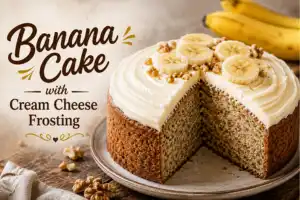
Use your parchment cradle to lift the fully cooled cake out of the pan and place it on a fresh sheet of parchment paper or a serving board. Scoop the frosting onto the top of the cake and spread it using an offset spatula. You can go for a perfectly smooth, even layer or use the spatula to create sweeping, organic swirls across the surface. Both look beautiful and taste identical. A light dusting of ground cinnamon over the top of the frosting adds a lovely visual touch and a little extra warmth in flavor. You can also lay a few banana coin slices across the top right before serving if you want to signal what flavor is waiting inside. Slice and serve, and prepare for compliments.
Variations in the Recipe
Add Toasted Nuts for Texture
If you want to give this cake a little more substance and crunch, toasted walnuts or pecans are the most natural addition. About three quarters of a cup stirred into the batter just before it goes into the pan is the right amount. Make sure you toast them first in a dry pan over medium heat for a few minutes until fragrant because raw nuts have a flat, slightly bitter taste compared to toasted ones. The nuttiness works beautifully against the sweetness of the banana and the richness of the cream cheese frosting, and it gives each slice a more satisfying chew without changing any of the core recipe steps.
Stir in Chocolate Chips
Chocolate and banana are one of those pairings that just always works, no matter what form they show up in. Stirring three quarters of a cup of semi-sweet chocolate chips into the batter before baking gives you little pockets of melted chocolate throughout the cake that are genuinely wonderful. You can go dark chocolate chips for a more intense contrast with the sweet banana flavor, or milk chocolate chips if you want something softer and more dessert-forward. You can also combine chocolate chips and toasted nuts together in the same batter for a banana rocky road type situation that is just as good as it sounds.
Change Up the Spices
Cinnamon is the default here and it works perfectly, but it’s far from the only option. You could swap it out for a quarter to half teaspoon of cardamom for something a little more exotic and floral, or use nutmeg for a warmer, slightly more intense spice note. A small amount of allspice or mace also works beautifully with banana. If you want a blend, a combination of cinnamon, nutmeg, and a tiny pinch of clove gives you something that feels much more layered and complex without requiring any extra effort. Just keep the total amount of spice in a similar range to avoid overpowering the banana flavor that is the star of the show.
Make it Without the Frosting
While the cream cheese frosting is what takes this cake over the top, the cake itself is so moist and flavorful that it genuinely stands on its own without any frosting at all. If you’re making it for a breakfast situation or a casual afternoon snack, skip the frosting entirely and serve it as is. A light dusting of powdered sugar over the top is a nice middle ground that adds just a little visual appeal and sweetness without the full richness of a frosted cake. It’s also a great option if you’re packing slices for lunch boxes or sending the cake with someone who prefers things less sweet.
Mistakes to Avoid
Using Bananas That Aren’t Ripe Enough
This is the number one mistake people make with banana baked goods and it genuinely affects the final result in a major way. A yellow or slightly green banana is mostly starch and has very little of the deep, sweet banana flavor you’re after. A fully ripe, spotty, brown banana has gone through a natural conversion process where all those starches have turned into sugars, and that’s what gives your cake its flavor, its moistness, and its natural sweetness. If your bananas aren’t ripe enough, bake them unpeeled at 350°F for 10 minutes before you start. It’s a small step that makes a real difference.
Scooping Flour Directly From the Bag
If you’re measuring flour by volume with cups rather than by weight, how you get the flour into the cup matters enormously. Scooping the measuring cup directly into the flour bag compacts the flour and can give you significantly more than the recipe intends, which leads to a dense, dry cake. The correct method is to fluff the flour first with a spoon, then spoon it into the measuring cup until it’s heaped above the rim, and then level it off with a straight edge. This gives you the right amount every time. Better yet, use a kitchen scale and weigh it to 420 grams.
Overmixing the Batter After the Flour Goes In
This is the mistake that ruins more home cakes than almost any other and it’s completely invisible until you take your first bite and something feels off. The moment flour enters the batter, gluten development begins. The more you mix, the more gluten develops, and the result is a cake that bakes up dense, slightly gummy, and chewy rather than light and tender. Stop the mixer when you can still see streaks of flour and finish with a spatula by hand. It feels wrong to leave the mixer running less than you think you should, but this is the right move and the cake will thank you for it.
Frosting the Cake Before It’s Fully Cool
Cream cheese frosting is soft and spreadable at room temperature, which is exactly what you want. But when you spread it onto a warm cake, the heat softens the frosting even further and it slides right off, pooling around the base and soaking into the surface of the cake rather than sitting on top of it. Give the cake at least a full hour to cool at room temperature, or speed things up by placing it in the fridge once it’s no longer hot to the touch. A completely cool cake means a perfectly set layer of frosting that stays exactly where you put it.
Not Scraping the Mixer Bowl Down Regularly
This sounds like a small thing but it makes a real difference in the consistency of your finished batter. Butter and sugar like to hide at the bottom and around the sides of the bowl where the paddle can’t quite reach them, and if you don’t scrape those spots down regularly throughout the mixing process, you end up with pockets of unmixed butter or clumps of sugar in the batter. Scrape down the bowl after creaming the butter and sugar, halfway through adding the eggs, and again before you start adding the flour and banana mixture. A couple of extra scrapes throughout takes ten seconds each and ensures a completely even, smooth batter every time.
Conclusion
This banana cake is the kind of recipe that becomes a go-to and stays there permanently. It’s not complicated, it doesn’t require any unusual equipment or specialty ingredients, and yet the result is something that genuinely impresses people every single time. The combination of very ripe bananas, a properly creamed butter base, and the alternating mixing method gives you a cake that is tender and moist all the way through without being dense or heavy. And that cream cheese frosting is the kind of thing people scrape off the plate. Make it once and it will earn a permanent place in your baking rotation, no question.
FAQs
Can I make this as a layer cake instead of a sheet cake? Yes, you can divide the batter between two 9-inch round cake pans and bake at 350°F for around 30 to 35 minutes, checking with a skewer for doneness. The cream cheese frosting works perfectly as a filling between layers and on the outside. Just make sure the layers are completely cool before stacking.
How do I store leftover banana cake? Because of the cream cheese frosting, leftover slices need to be kept in the refrigerator in an airtight container. They’ll keep well for up to 4 days. Let slices come to room temperature for about 20 minutes before eating for the best texture and flavor.
Can I freeze this cake? Yes, this cake freezes beautifully both frosted and unfrosted for up to 3 months. Wrap individual slices or the whole cake tightly in plastic wrap and then in foil before freezing. Thaw overnight in the fridge and bring to room temperature before serving.
My batter looks curdled after adding the eggs. Did I do something wrong? This usually happens when the eggs are too cold or when they’re added too quickly. It can also happen if the butter wasn’t fully softened to begin with. The batter will generally come back together once the flour is added, so don’t panic. To prevent it next time, make sure your eggs are at room temperature before they go in.
Can I reduce the sugar in this recipe? You can reduce the granulated sugar slightly without significantly affecting the structure of the cake, but brown sugar contributes to moisture as well as sweetness, so be cautious about reducing it too much. The bananas already bring natural sweetness, so if your bananas are very ripe, you have a little room to pull back on the added sugar if you prefer a less sweet result.
What’s the best way to quickly ripen bananas? The oven method mentioned in this recipe works great. Place unpeeled bananas on a baking sheet and bake at 350°F for about 10 minutes until the skins turn black and the fruit inside is soft and fragrant. Let them cool before peeling and mashing. Alternatively, leaving bananas in a warm spot in your kitchen for a day or two speeds up ripening naturally.